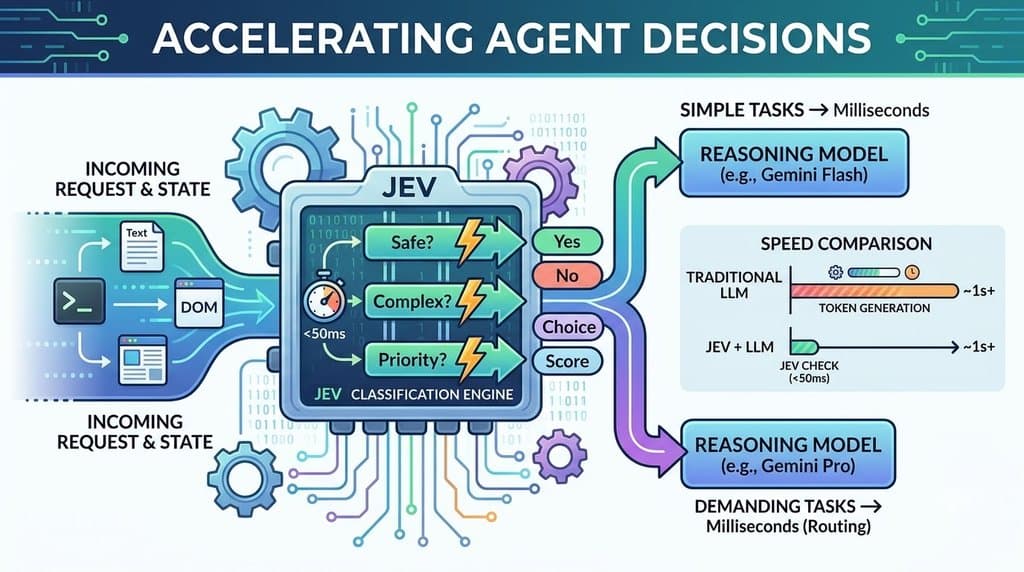
Most coding agents lean on a general-purpose LLM for everything — including decisions that don't need a paragraph of reasoning, just a fast yes, no, or pick-one-of-three. Ask Gemini or Claude "is this shell command safe to run?" and even with structured output forced on, the model still has to generate tokens: braces, quotes, field names, values. That generation tax can add a full second or more to what should be an instant check, and in an agent loop that fires dozens of these checks a minute, it adds up fast.
Jev, from TypeSafe AI, is built to remove that tax entirely. It isn't a chat model — it's a classification model. Feed it some state and a set of questions, and it returns typed answers in roughly 50 milliseconds, with no text to parse afterward.
How it actually works
A call to Jev takes two inputs: state (whatever context you want evaluated — a shell command, a support ticket, a page's DOM) and one or more questions about that state. You can batch several questions into a single request and Jev evaluates them in parallel, each returning one of three primitive types:
- Choice — picks the best match from a fixed set of labeled options
- Score — places the input on a numeric or leveled scale
- Noul (boolean) — a probability between 0 and 1 that a statement is true
Every answer comes back with a confidence value attached, so you're not just getting a label, you're getting how sure the model is about it.
What Jev is explicitly not trying to do is replace your reasoning model. It sits alongside a chat model as a fast evaluation layer, not in place of one — the two are meant to be paired, not swapped.
How fast is fast
The speed unlocks decision patterns that would be impractical with a chat model in the loop. One widely shared example: developer Gregor Zunic built an open-source agent that used Jev to navigate Google Flights and complete a Zurich-to-London booking in about 7 seconds, by scoring every possible click and input target on the page in a single ~15ms pass rather than reasoning through the page step by step.
Wiring it into Google Antigravity
The fastest path to trying Jev inside an agentic IDE like Antigravity, Codex, or Claude Code is TypeSafe's official skill:
- Grab the install prompt from TypeSafe's docs and paste it directly into your agent — it will pull down the skill for you rather than requiring a manual terminal install.
- Once it runs, you'll see a
SKILL.mdfile from TypeSafe drop into your project directory. - Generate an API key from the TypeSafe console and save it wherever your agent expects secrets.
From there, TypeSafe's docs include starter prompts — one useful one is simply asking your agent to brainstorm where Jev-style fast decisions would fit into your existing project.
A practical example: model routing
One concrete build: prompting Antigravity to write a router.py that uses the Jev skill to pick which model handles an incoming task — Gemini Flash for simple ones, Gemini Pro for anything more demanding. Running it shows exactly what you'd expect: straightforward tasks get classified and routed to Flash in milliseconds, harder ones get flagged for Pro, and the whole routing decision happens before the "real" model call even starts.
Where Jev falls short
A few real constraints worth knowing before you reach for it:
- It reads literally. Jev evaluates exactly what your criteria say, not what you meant. Vague or ambiguous question wording will produce vague or wrong answers — be explicit.
- It's not built for large context. Dumping an entire codebase or long transcript in as state and hoping it "figures out" what matters doesn't play to its strengths.
- It's a classifier, not a writer. Anything that needs generated prose — essays, conversational replies, explanations — is outside its lane and will fail if you force it there.
The takeaway
Jev isn't a smaller, cheaper Gemini — it's a different tool for a different job. Swap out the narrow, high-frequency yes/no/pick-one decisions inside an agent loop, and you cut a second of generation latency down to about 50 milliseconds, without touching how the agent reasons about everything else.