Start with what is free
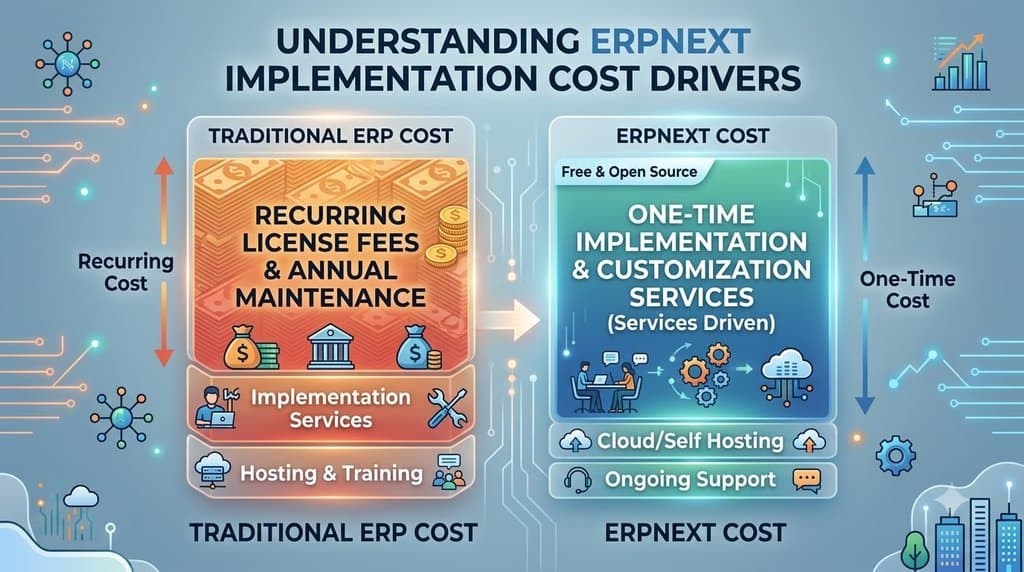
ERPNext is open source under the GNU GPL v3. There is no per-user licence, no per-module licence and no annual maintenance fee to a vendor; the source code is yours to read, extend and host wherever you like. That single fact changes the shape of an ERP budget more than anything else on this page. With a licensed ERP the recurring licence is often the largest line and it never goes away. With ERPNext the bill is almost entirely services and hosting, and most of it is spent once, up front, in the months between kick-off and go-live.
It also means the question "what does ERPNext cost in India?" has no honest one-number answer, because the number is the implementation, and the implementation is a function of your company. What we can do — and what this article does — is show you exactly what sets it, what a serious quote looks like, which costs never appear on a quote, and what the spend has bought back for the companies we have taken live. It is written from our own ERPNext implementation projects: a manufacturer and exporter, a CNC machine-tool plant, a corporate learning platform and two government programmes.
You will not find a rate card here, for the same reason it is not on our services page: a number without a scope is a guess, and a guess is how ERP projects end up over budget. What you will find is enough to estimate your own project and to judge whether the quotes you receive are serious.
The five things that set the number
Every ERPNext quote we have written moves on five variables. User count is deliberately not one of them.
1. Modules and companies in scope
The base of any implementation is the core that every business needs: accounting, buying, selling and stock, with Indian GST configured into the transactions. Each module beyond that adds configuration, testing, training and data. Manufacturing adds bills of materials, work centres, routings and production planning; quality adds inspection plans; HR adds payroll, which in India means statutory components and a month-end that has to be right the first time. Prem Plumbings went live with the chart of accounts, purchasing, sales, multi-warehouse stock with reorder levels, GST-compliant invoicing and returns, and Frappe HRMS with payroll posting into the same ledger — a broad scope, and priced as one. Our own HRMS and accounting platform is narrower in module count but carries an integration on top: a customer-facing assistant that records into the same database.
A second company on the same instance is not free either. Each legal entity brings its own chart of accounts, opening balances, GST registrations and users, and often its own way of doing the same process. Multi-site stock is a similar multiplier.
2. Depth of customisation
This is the variable with the widest range, and the one to watch in a quote. There are three levels and they are not close in cost. A configuration change — a workflow, a print format, a custom field, a report built in Frappe's report builder — is hours. A new doctype with its own logic, permissions and screens is days to weeks. A whole application on the Frappe framework is a product build. A reorder-level report or a dashboard over standard transactional data sits at the first level. The CRM running beside HRMS at Land Group and the conversation and escalation layer behind our own site assistant sit at the third — custom Frappe applications that happen to share a framework with ERPNext, delivered in releases over months.
The trap is customising what should have been configured. Every custom change is something to re-test at the annual upgrade, and heavy customisation is how an open-source ERP acquires a maintenance cost that looks like a licence fee.
3. The state of your data, and how much history you migrate
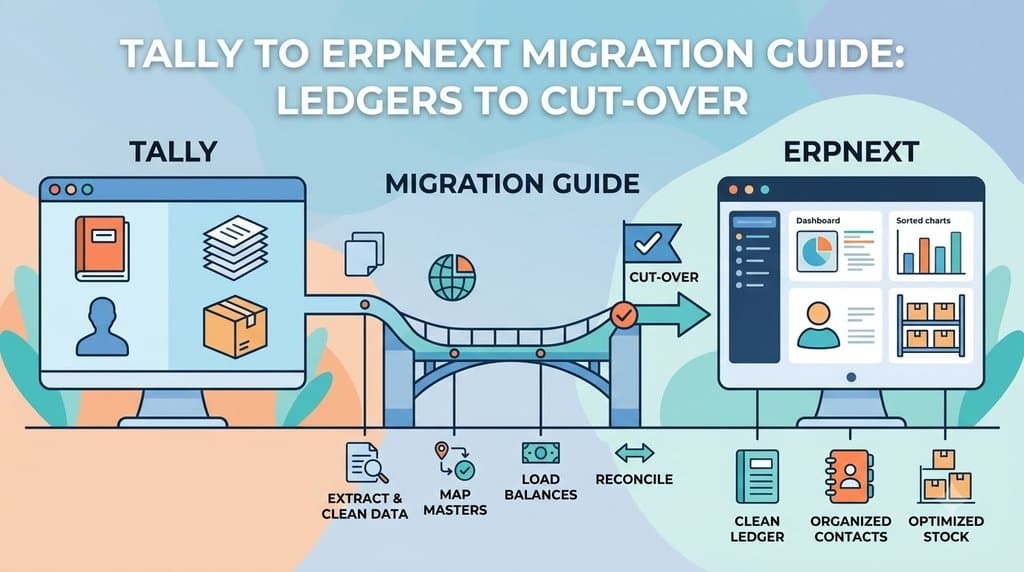
Most Indian mid-market companies come to ERPNext from Tally, Excel, or an older ERP, and the data is in the state you would expect after years of growth: a customer master with three spellings of the same name, item codes that mean something to one person, stock that the spreadsheet and the warehouse disagree on. Cleaning masters, reconciling opening balances and deciding how far back transaction history must migrate is its own workstream, and its cost tracks the mess, not the module count. Migrating opening balances plus the current financial year is a different job from migrating ten years of ledgers. We keep the Tally migration reversible until the finance team trusts the new ledger, and that parallel period has a cost too.
4. Integrations
Banks, e-commerce channels, biometric attendance devices, GST filing suites, a CRM the sales team will not give up. Each integration is scoped, built and tested on both sides, and each one that touches money or compliance needs reconciliation built in. Our own site assistant is an integration of this kind: it writes every website conversation back into Frappe as a document over the REST API and escalates it to a human with the thread attached, which is what makes an out-of-hours enquiry a record rather than a missed call.
5. Hosting
ERPNext runs three ways and the choice affects both the one-off and the monthly cost. Frappe Cloud is the quickest to start and includes managed backups and upgrades, on published plans. A self-hosted bench on AWS, Azure or an Indian data-centre VPS is what most of our manufacturing clients choose for cost and control at scale. On-premise or a sovereign cloud is for when data residency demands it, and that decision is made for the regulator first and for cost second. Whichever you choose, budget for the same operational baseline: a Docker-based setup, nightly off-site backups, monitoring and a tested restore procedure before go-live.
Notice what is missing. User count moves the hosting size a little and the training days a little, but it does not move the implementation the way it does with a per-seat product. Fifty users and fifteen users on the same scope cost nearly the same to implement.
What the timeline tells you about the cost
Because the cost is almost all people's time, the timeline is the best proxy for the number before discovery. From our projects, a single-company rollout of accounting, buying, selling and stock for 10–50 users typically goes live in 8–12 weeks from kick-off. Add manufacturing with quality and traceability, or multi-site operations, and 4–6 months is realistic. A bespoke Frappe platform — a state-wide programme, a corporate learning system — is a product build of 4–9 months, delivered in releases.
Behind those weeks is a small team whose composition barely changes: a functional consultant who knows the modules and Indian compliance, a Frappe developer for the customisation and integration list, someone who owns data migration, and a project lead who is usually part-time. The consultant and developer are the cost; the difference between an 8-week and a 6-month project is mostly how many weeks of them the scope needs, not how many of them there are.
How a serious quote is structured
A quote for an ERP is only as trustworthy as the scope it is attached to, so the structure matters as much as the total. This is how we price, and it is a fair test for any quote you receive.
Discovery and fit-gap, fixed fee, 2–4 weeks. We interview each function, document how the company actually runs, map it onto ERPNext, and produce a gap register and a costed, phased rollout plan. You leave with the process maps, the gap register and the plan whether or not you go ahead with us. Discovery exists so that the implementation estimate is a number rather than a range.
Implementation, fixed price for the agreed scope, with change control. After discovery the scope is known, so the price can be fixed: the number you sign is the number you pay. Anything outside the gap register is a change request, priced separately, which is what protects both sides. The quote should be itemised by phase — configuration, customisation (each item from the gap register), data migration, integrations, training — so you can see where the money goes and take things out.
Hypercare, included. A month of on-call support through the first month-end close and the first payroll is part of every implementation, not an extra.
Support, monthly retainer. After hypercare most clients keep a retainer covering user questions, small configuration changes, period-end help and the annual version upgrade. Larger changes — a new module, a new site, an integration — are scoped as small projects.
Hosting, separate. Cloud or VPS charges are passed through or paid by you directly. They should never be bundled into a services figure where you cannot see them.
The costs that are not on the quote
These are the lines that decide whether the project comes in on budget, and no vendor can price them for you.
- Your own people's time. Process owners in discovery, a data owner cleaning masters, users in acceptance testing, and everyone in training. An ERP project that does not have this time will stall, and the stalls are what generate change requests.
- Process decisions. ERPNext will ask questions your company has never had to answer in one voice: who approves a purchase above a threshold, when stock is considered received, how a sales return is valued. Every decision made before configuration is cheap; every one made after go-live is a change.
- The parallel run. If finance keeps Tally alongside ERPNext until the first close reconciles, that is a period of double entry. It is worth it. Budget the time.
- Hardware at the edge. Barcode scanners and label printers for the warehouse, biometric devices for attendance, a tablet on the shop floor. Small individually, forgotten collectively.
- The second phase. The module you deferred, the second site, the integration that was "later". Phasing is the right way to run an ERP; just keep the later phases in the plan and the budget, not in the future.
Where the money goes wrong
Most ERPNext overruns we are called in to rescue share a cause, and it is rarely the software. A reseller was hired where an engineering team was needed, so every gap became a change request instead of a small piece of Frappe code. Discovery was skipped to save its fee, and the scope was discovered during configuration instead, at implementation rates. The system was customised to reproduce the old process exactly, then broke at the first upgrade. Ten years of history was migrated when opening balances and one year would have done. Go-live was a single big bang across every function on a month-end. Or support was not budgeted, so the annual upgrade never happened and the instance drifted out of date.
Each of those is avoidable in the plan, which is why the plan is the thing discovery produces.
How to bring the number down without hurting the outcome
Stay on standard modules and configure them carefully; customise only what the gap register proves you need, and build it as a Frappe app rather than patching core. Phase the rollout by function and retire the old process as each goes live — Prem Plumbings went module by module, so the business never stopped trading and was never running two systems for the same job for longer than necessary. Clean the masters yourselves before migration; you know the data and the consultants do not. Migrate opening balances and limited history, and archive the rest where it can still be read. Make the process decisions before configuration starts. Self-host once you have the scale and the operational discipline for it. And train trainers — a few power users who then train the floor — rather than paying for every seat to sit in a classroom.
What the spend buys back
The payback from an ERPNext implementation shows up first in the monthly cycle and in stock. The mechanism is the same in every project we have delivered, and it is worth being precise about what actually changes:
- The month-end assembly job disappears. At Prem Plumbings the same numbers used to be gathered by hand every cycle from spreadsheets and standalone tools. GST invoicing and returns are now produced from the same ledger that recorded the transaction, so filing stops depending on a reconciliation that had already proved unreliable during the month.
- Availability becomes a query rather than a count. Multi-warehouse stock with reorder levels means the purchase cycle is driven from the system instead of from memory, and stock on paper and stock on the shelf stop drifting apart.
- Payroll stops being journalled across. When HR and finance are the same database, payroll posts to the accounts directly. The monthly step where somebody remembers to move the numbers between two systems is not made faster; it is gone.
- The data collection exercise ends. At Zara Interiors payroll is calculated from attendance and leave data already recorded through self-service, rather than from information chased across sites each month.
Put that against a project that is priced once and hosted at commodity rates, and the arithmetic is usually straightforward. A finance team's month-end time recovered, or carrying less stock because reorder levels are enforced rather than remembered, is the kind of return that pays for the implementation on its own — and, unlike a licence, the cost does not recur. We will not quote you someone else's percentages; the honest version is that the size of the return tracks how manual the current month-end is, which is exactly what discovery measures.
Getting a number for your company
Send us the modules you think you need and the systems you use now — Tally, Excel, an older ERP — and which of the five drivers above you expect to be the hard one. We come back within a week with a discovery proposal and a realistic timeline, and after discovery with a fixed price for the scope you have agreed. Talk to us; if ERPNext is not the right fit for your company, we will say so at the discovery stage, when it is still cheap to hear.