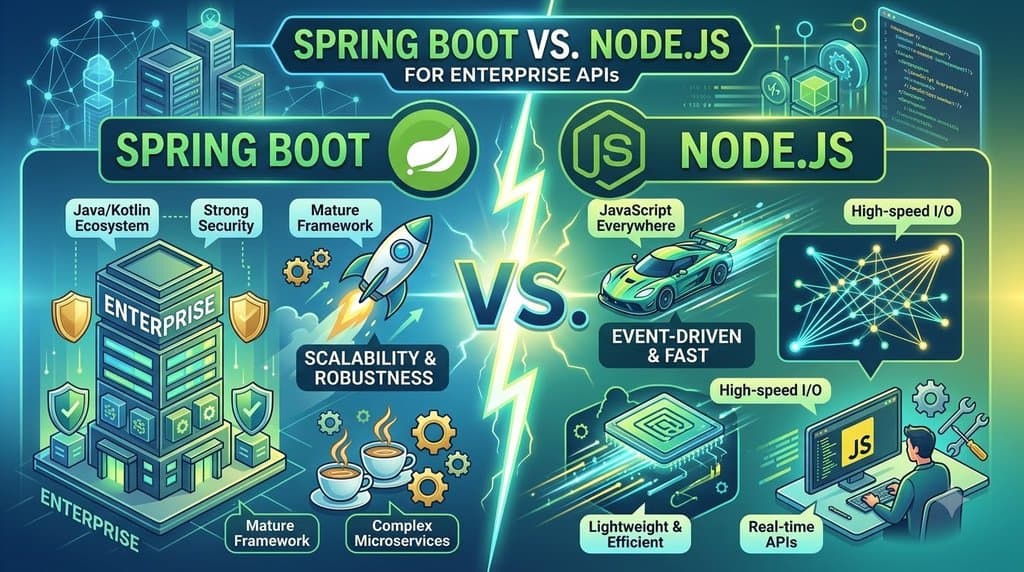
The Spring Boot vs Node.js question comes up in every backend engagement. Both are production-proven, both have mature ecosystems, and both can handle enterprise workloads. The decision framework is more interesting than the outcome.
When we choose Spring Boot
Spring Boot is our default for APIs that are computation-heavy, have complex domain models, or need to integrate with the broader Java enterprise ecosystem. The specific scenarios where Spring Boot wins:
- Complex business logic: Spring's dependency injection and module system make large, complex domain models easier to structure and test
- Existing Java investment: many enterprise clients have Java teams, Java libraries, and Java-based integrations — working with Spring Boot respects that investment
- Type safety at scale: Java's strong typing catches a category of bugs at compile time that JavaScript's type system misses even with TypeScript
- JVM ecosystem: Hibernate for ORM, Spring Security for auth, Spring Batch for ETL jobs — mature, well-understood, well-staffed
When we choose Node.js
Node.js is our default for APIs that are I/O-bound, latency-sensitive, or need to be built by a team that works primarily in JavaScript/TypeScript. The specific scenarios:
- High-concurrency APIs with lightweight request processing — Node's event loop handles thousands of concurrent connections efficiently
- Real-time features: WebSockets, server-sent events, and streaming APIs are more natural to build in Node
- Full-stack TypeScript teams: sharing types and logic between frontend and backend is a real productivity gain
- Rapid iteration requirements: the Node ecosystem's package availability and the lower ceremony of JavaScript projects accelerates early-stage development
The throughput benchmark trap
Performance benchmarks comparing Spring Boot and Node.js are abundant and almost entirely useless for real decisions. Both platforms, tuned correctly, exceed the throughput requirements of virtually any business application. We've never had a client whose API was the throughput bottleneck — the database almost always is.
Choosing a backend framework based on synthetic benchmarks is like choosing a car based on top speed when you'll be driving in city traffic. The constraints that matter are team familiarity, ecosystem fit, and operational complexity.
The hybrid approach
In several enterprise deployments, we've used both: Spring Boot for the core domain API (orders, inventory, billing) and Node.js with FastAPI for the integration and event-processing layers. This isn't premature architecture — it's choosing the right tool for distinct, clearly bounded problem types.
What we ask before making the decision
- What is the team's strongest backend language? This matters more than any technical consideration.
- What does the integration landscape look like? SOAP-heavy enterprise integrations favour Java; REST-first modern APIs are equally comfortable in either.
- What are the operational requirements? Spring Boot on Kubernetes with a Java ops team is operationally simpler than Node.js for the same team.
- What's the likely tenure of this system? Java projects are more likely to find developers in five years. The Node.js talent market is large but moves faster.
The answer to the Spring Boot vs Node.js question is almost always: whichever one the team is best at, chosen deliberately rather than by default.