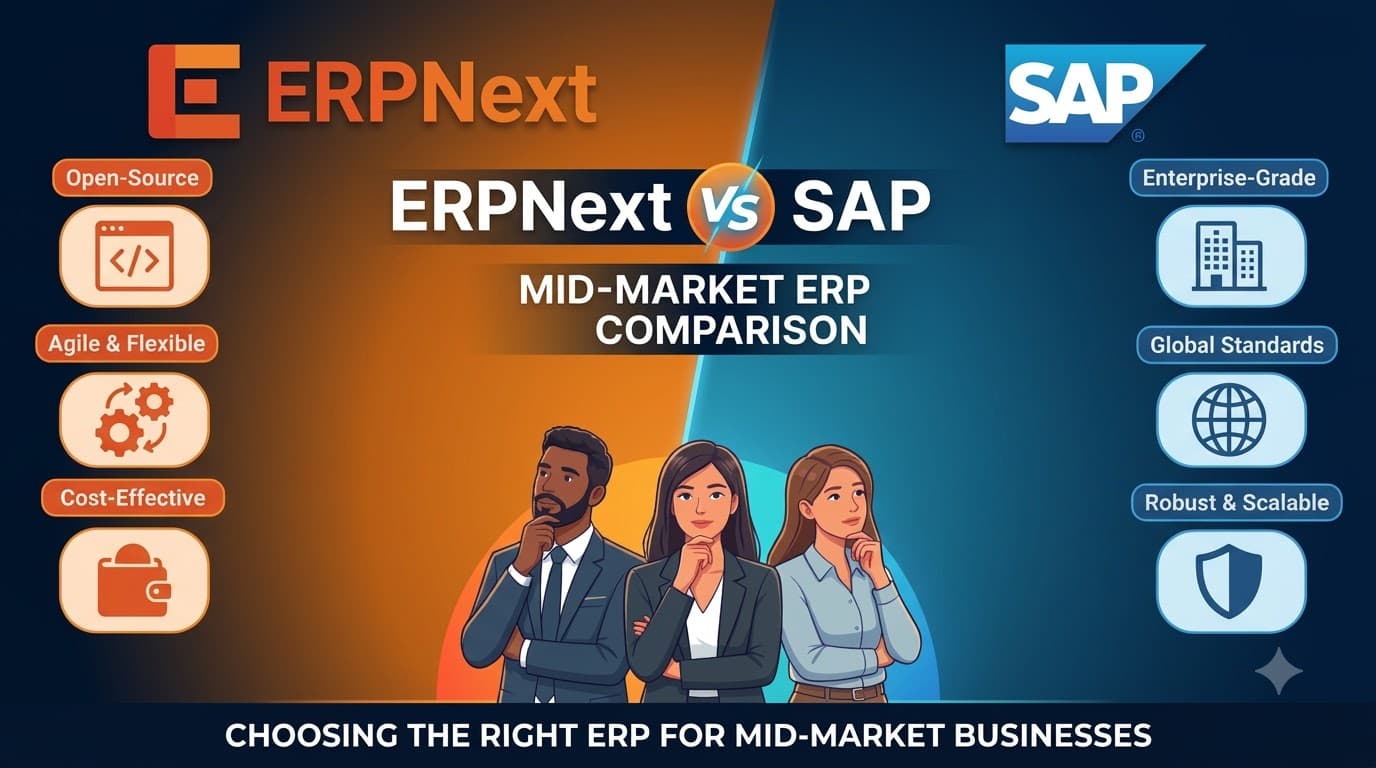
When a mid-market manufacturer tells us they're evaluating ERP, SAP Business One is almost always on the shortlist — not because it's necessarily the best fit, but because SAP is the name people know. This post is an honest comparison based on implementations we've done on both platforms.
Where SAP Business One wins
SAP Business One is a mature platform with a large certified partner ecosystem, strong financial reporting, and deep integration with other SAP products. If your organisation already runs SAP at the group level, Business One as a subsidiary ERP makes clear sense — the consolidation story is well understood.
For manufacturers with complex multi-currency, multi-entity requirements and a large internal IT team, SAP Business One's depth is genuinely valuable. The platform has been around since 2002 and the edge cases are covered.
Where ERPNext wins for mid-market
ERPNext is open source, built on the Frappe framework, and has been production-ready for serious manufacturing use cases for several years. The areas where it consistently outperforms SAP Business One for our target clients:
- Total cost of ownership: licensing alone saves 60–80% over SAP Business One; partner implementation costs are also lower because the platform is simpler to extend
- Customisation speed: adding a custom field, a custom report, or a workflow step in ERPNext takes hours, not days, and doesn't break on updates
- Manufacturing module depth: job cards, BOM versioning, subcontracting, quality inspections — ERPNext's manufacturing module covers the full shop floor workflow
- Upgrade path: Frappe/ERPNext upgrades are community-driven and regular; we've upgraded clients from v13 to v15 without the multi-month projects that SAP upgrades often require
The honest limitations of ERPNext
ERPNext is not the right answer for every manufacturer. The limitations that matter:
- Financial consolidation across many legal entities is less mature than SAP's — manageable for 2–4 entities, complex beyond that
- The partner ecosystem is smaller, which means you need to choose your implementation partner carefully
- Out-of-the-box reporting is functional but not as polished as SAP's — clients who want boardroom-ready reports out of the box need Power BI or similar on top
- Indian payroll and statutory compliance modules are excellent; GCC and Malaysian compliance is good but sometimes requires customisation
Our decision framework
We recommend ERPNext when: the client has 50–500 employees, one to three legal entities, a manufacturing or project-based business model, and no existing SAP investment to protect. The ROI case is straightforward and the implementation timeline is 3–5 months rather than 9–18.
We recommend SAP Business One when: the client is a subsidiary of a SAP-standard group, has complex multi-entity financial requirements, or has specific industry certifications that require SAP certification.
The migration question
We've also migrated clients from SAP Business One to ERPNext — usually when licensing costs have become unsustainable or the implementation partner relationship has broken down. These migrations are manageable with proper data mapping and a 4–6 week parallel-run period. The data model translation is the hard part; the rest is configuration.