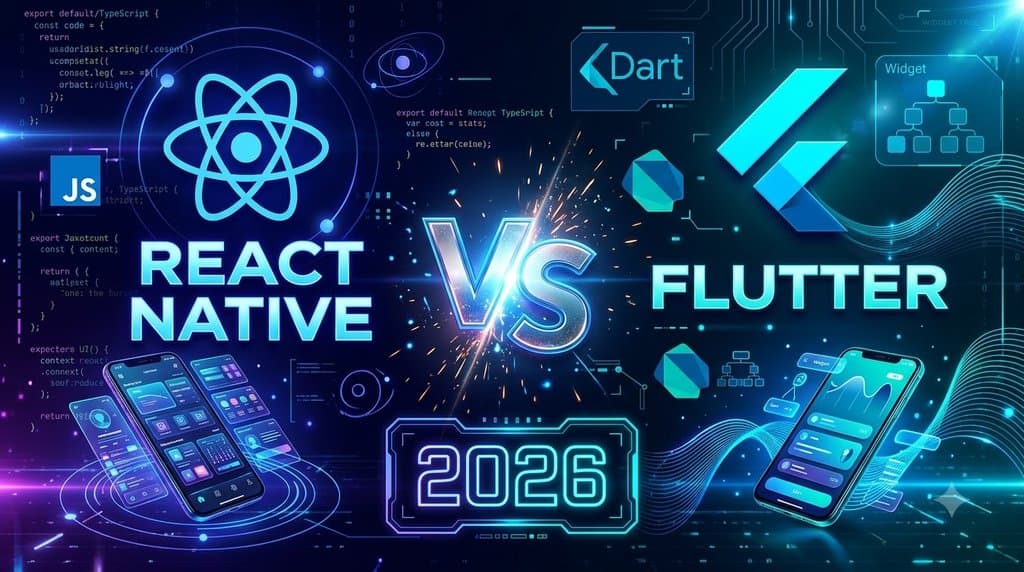
The React Native vs Flutter debate has been running for five years. In 2026, both frameworks are genuinely production-ready and both have significant enterprise deployments behind them. The choice is less a technical question and more a team and ecosystem question.
Where we start the conversation
Before we talk framework, we ask two questions: What does your web team look like? And what are the performance requirements of the specific features you're building?
If a client has a strong React/TypeScript team and the app is data-heavy with standard native UI components — dashboards, lists, forms — React Native is almost always the right choice. The shared context with their web codebase reduces the team size needed and accelerates delivery significantly.
If the app has custom UI components, complex animations, or needs to look and behave identically across iOS and Android (often a requirement for consumer-facing apps), Flutter's rendering model gives better consistency.
React Native in 2026: the new architecture changes things
React Native's new architecture — JSI, Fabric, and TurboModules — has been in progressive rollout since 2023. By 2026, the majority of production apps we build are on the new architecture, and the performance characteristics have changed materially.
- Synchronous JavaScript/native communication via JSI eliminates the bridge bottleneck that caused frame drops in complex scrolling lists
- Fabric's concurrent rendering integrates properly with React 18 concurrent features
- TurboModules allow lazy loading of native modules, reducing startup time
- The Metro bundler with hermes optimisation now produces genuinely small bundle sizes
Flutter's strengths remain consistent
Flutter's competitive advantages haven't changed since 2021 — they've just become more mature:
- Pixel-perfect custom UI is genuinely easier — the widget tree owns the rendering, so what you design is exactly what ships on every device
- Dart's strong typing catches more errors at compile time than TypeScript typically does in practice
- Flutter's Impeller rendering engine (now stable on both iOS and Android) has closed the animation performance gap with native
- The single codebase now extends to web, desktop, and embedded — useful for clients with multiple surface targets
What we actually choose
For enterprise clients with existing React/web teams: React Native. The skill overlap is too valuable to ignore, and the new architecture has resolved most of the historical performance criticisms.
For greenfield consumer apps where UI fidelity and animation quality are the primary success criteria: Flutter. The design-to-code workflow is tighter and the output is more consistent.
For native iOS or Android when required by client policy, platform-specific APIs, or existing codebases: we build native. There's no framework that beats native for deeply platform-integrated features.
The question we're asked most often
"Will we be able to hire developers for this?" For React Native, yes — the pool of React developers who can move to React Native is large. For Flutter, the Dart-specific pool is smaller but growing faster than any other mobile framework. In India specifically, Flutter developer availability has improved dramatically since 2023.