
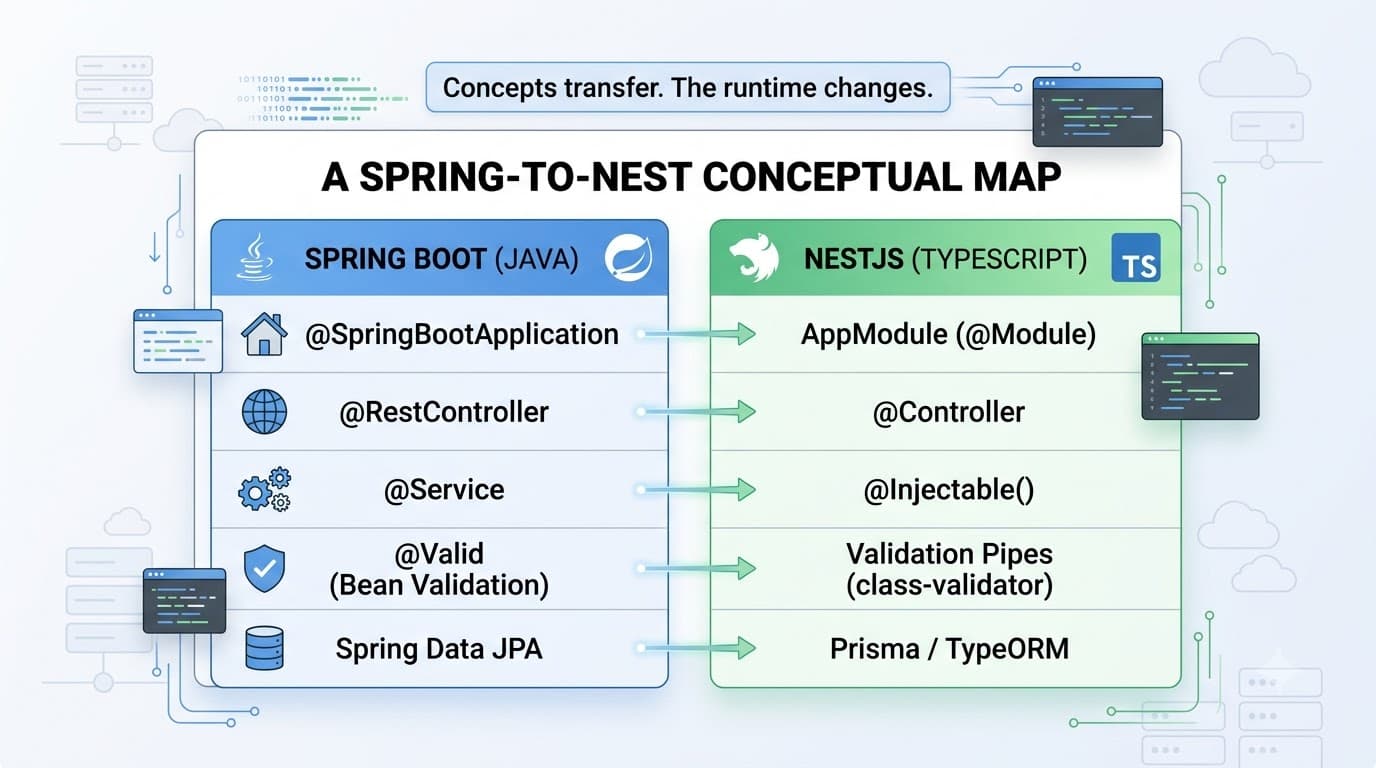
Why Spring teams end up in NestJS
The situation is common enough to have a shape. An organisation has a Java estate — Spring Boot services, a team that thinks in beans and annotations — and a growing set of JavaScript front ends: React, Next.js, React Native. Somewhere between them a new service is needed that is I/O-bound, front-end-adjacent and TypeScript-shaped: a backend-for-frontend that aggregates three Spring APIs into what the mobile app actually wants, a real-time layer, a webhook consumer, an integration hub. Node.js is the right runtime for it, and the question becomes how to build it so the Java team can own it rather than fear it.
NestJS is the answer we give, and this article is why. It was designed around the same ideas — modules, providers, decorators, dependency injection — that Spring developers already carry in their heads, so the concept map is short and the productive period is days, not months. In our Node.js practice it is the default for any service that will live for years; plain Express or Fastify stay in the toolbox for small, single-purpose services and serverless handlers. What follows is the map we walk a Spring team through, the places where the map lies, and how we run the first project so the second one needs no help.
The concept map
Most of what a Spring developer knows transfers almost one-to-one. The names change; the shapes do not.
- The application and its wiring.
@SpringBootApplicationwith component scanning becomes an explicitAppModule. A Nest@Moduledeclares itsimports,controllers,providersandexports; there is no classpath scanning, so what a module can see is written down. Spring teams tend to like this once they stop missing the magic — the module graph is the architecture diagram. - Controllers.
@RestController+@RequestMappingbecomes@Controller('orders')with@Get(),@Post()and friends.@PathVariableis@Param(),@RequestBodyis@Body(),@RequestParamis@Query(). A method returns a value or a promise; Nest serialises it. - Services and injection.
@Service,@Componentand@Repositorycollapse into@Injectable(). Injection is constructor-based, which is the Spring best practice anyway; providers are singletons by default, withScope.REQUESTavailable when you genuinely need per-request instances (and the same performance caveat Spring's request scope carries). - Validation. Bean Validation's
@Validand@NotNullbecomeclass-validatordecorators on a DTO class, enforced by a globalValidationPipe. We run it withwhitelistandtransformon, so unknown fields are stripped and query strings arrive as the declared types. Pipes in general are the transformation-and-validation hook Spring spreads across converters and argument resolvers. - The request pipeline. Spring's servlet filters and
HandlerInterceptormap to Nest middleware and interceptors;@ControllerAdvicewith@ExceptionHandlermaps to exception filters; Spring Security's filter chain and@PreAuthorizemap to guards, usually backed by Passport strategies for JWT or OIDC. The order — middleware, guards, interceptors, pipes, handler, interceptors again, filters — is documented and fixed, which is more than can be said for a hand-tuned filter chain. - Data access. Spring Data JPA has two plausible counterparts. TypeORM is the closer cousin — entities with decorators, repositories, both Active Record and Data Mapper styles. Prisma is schema-first with a generated, fully typed client, and is what we reach for on new PostgreSQL and MySQL services because the types flow from the schema into the code with no drift. Mongoose covers MongoDB.
- Scheduling, async work and events.
@Scheduledbecomes@Cron()from@nestjs/schedule.@Asyncand the JMS or RabbitMQ listener has a more deliberate counterpart: BullMQ queues on Redis through@nestjs/bullmq, with retries, idempotency keys and dead-letter queues designed in.ApplicationEventPublisherbecomes@nestjs/event-emitterfor in-process events. - Configuration.
application.yml,@Valueand@ConfigurationPropertiesbecomeConfigModulewith a validation schema, so a missing or malformed environment variable fails the boot rather than the first request that needs it. - API documentation. springdoc-openapi becomes
@nestjs/swagger; decorators on DTOs and controllers generate the OpenAPI document, and the CLI plugin infers most of it from the types. We generate the front end's TypeScript client from that document, which is the point of the whole exercise. - Operations. Actuator's health and metrics become
@nestjs/terminushealth checks, pino structured logging and OpenTelemetry tracing — added to the skeleton, not to the backlog. - Testing.
@SpringBootTestandMockMvcbecomeTest.createTestingModule()for wiring a module with overridden providers and Supertest for driving the HTTP layer, under Vitest or Jest, against real containers rather than mocks for the database.
A Spring developer reading that list will notice that nothing in it needed explaining twice. That is the whole case for NestJS over a looser framework when the team comes from Java: it is not that Express cannot do these things, it is that a Spring team will reinvent all of them, differently, on each service.
Where the map lies
The transfer is close enough to be dangerous, because the runtime underneath is nothing like the JVM. These are the differences we teach explicitly, because each one has produced a production incident somewhere.
There is one thread
The JVM gives Spring a thread per request; blocking in a handler costs one thread. Node gives you one event loop; blocking in a handler — a synchronous CPU-heavy transform, a large JSON parse, a badly chosen library that does synchronous I/O — stalls every request in flight. The rule for a Java team is simple to state and hard to internalise: a NestJS handler must never do more than a few milliseconds of CPU work. Anything heavier goes to a BullMQ worker, a worker_threads pool or a different service entirely. Our load-and-harden phase profiles the event loop for exactly this, and it is the check that catches the most.
The corollary is that ThreadLocal does not exist. Request context — the tenant, the user, a correlation ID — travels through Node's AsyncLocalStorage, which is what the nestjs-cls module wraps. A Spring team that used a request-scoped bean or a ThreadLocal for this has to learn the new mechanism early, or the pattern ends up as a parameter threaded through every method.
Types disappear at runtime
Java's types are real at runtime; TypeScript's are erased. Two consequences bite Spring developers immediately. First, you cannot inject by interface. constructor(private readonly repo: OrderRepository) works because OrderRepository is a class and the decorator metadata records it; an interface leaves nothing behind, so the injection is by class or by an explicit token with @Inject(ORDER_REPOSITORY). Second, a typed DTO is not validated by being typed. An incoming body that claims to match CreateOrderDto matches nothing until class-validator — or Zod at the boundary — has said so. Java teams are used to the compiler being the boundary; in Node the boundary is a pipe you have to switch on.
Transactions are explicit
@Transactional has no built-in equivalent. In Prisma a transaction is prisma.$transaction(async (tx) => { … }) and every query inside it must use tx; in TypeORM it is a QueryRunner or the transaction helper. There are decorator-based plugins built on nestjs-cls that restore something like @Transactional, and we use them where a service has many multi-step writes, but the default is explicit, and a Spring team that assumes the annotation is there will ship a service whose writes are not atomic. We put this on the code-review checklist for the first three months.
Failure looks different
A Spring service dies loudly when it runs out of heap and is restarted by its supervisor. A Node process has a default heap ceiling that is modest for a service holding large in-memory structures, unhandled promise rejections that terminate the process unless handled, and no JVM-style tuning culture around it. The answers are ordinary — set the heap explicitly in the container, treat an unhandled rejection as a bug in review, run replicas behind a load balancer rather than one big process — but they are not the answers a Java team already knows.
Packaging is not a fat JAR
Dependency management moves from Maven's curated, slow-moving world to npm's vast, fast-moving one. That is mostly good and occasionally alarming. We pin a package manager and its lockfile, build multi-stage Docker images that install only production dependencies, run a dependency audit in CI, and keep the direct dependency list short and boring. The supply-chain conversation that Java teams have once a year is one Node teams have every sprint.
What a Spring team gains
The trade is not one-sided. Startup time falls from tens of seconds to well under one, which changes how autoscaling and local development feel. Container images shrink. The front end and the backend share a language, a linter, a test runner and — the thing that pays back fastest — shared types: the DTOs and the OpenAPI document generate a client the React or React Native team consumes without a hand-written adapter, and a breaking change fails their build instead of their users. Strict-mode TypeScript with class-validator at the boundary gives a Spring team most of the safety they are used to, and the parts of Nest that map to Spring keep the codebase navigable at the size where Express projects usually turn into folklore.
How we run the switch
The first NestJS service in a Java estate is a cultural project as much as a technical one, so we run it on a fixed pattern.
Confirm the runtime before the framework. Our engagements start with a stack review — workload profile, team skills and the existing estate — that decides Node, Spring Boot or Python, documented rather than assumed. Node is the right call when the work is I/O-bound, the consumers are JavaScript clients or the team is TypeScript-native; it is the wrong call for CPU-heavy processing, batch jobs and regulated, transaction-heavy, long-lived systems, which stay on Spring Boot. We laid out that decision in Spring Boot vs Node.js for enterprise APIs; a Node BFF over Spring Boot domain services is one of the most common shapes we propose, and it is also the ideal first NestJS project — a clear boundary, a JavaScript consumer, and the domain logic safely where it was.
Start from a skeleton, not a blank repo. Every Node service we build begins from the same shape: strict TypeScript; NestJS modules with constructor injection; class-validator DTOs behind a global ValidationPipe; Prisma or TypeORM on PostgreSQL or MySQL; BullMQ workers on Redis; @nestjs/swagger generating the OpenAPI document and the front end's types from it; pino logging, OpenTelemetry tracing and terminus health endpoints; Vitest or Jest with Supertest against real containers; Docker images built in GitHub Actions or Jenkins and deployed to AWS, Azure or on-premise. The Spring team gets the equivalent of the starter they are used to, with the decisions already made.
Agree the contract with the front end first. The API contract phase produces the OpenAPI or GraphQL schema before the build starts, with the shared TypeScript types generated from it. For a team used to Java-first design this is the inversion that matters most: the client's needs shape the BFF, not the domain model.
Pair, and review for the runtime. Spring developers pair with a Node engineer for the first weeks, and the code-review checklist is explicit about the differences above: nothing blocking in a handler, no any, no injection by interface, transactions explicit, request context through AsyncLocalStorage, every unhandled rejection a defect. Within days the Spring developers are writing modules on their own; the review rules are what keep the first incident from happening in the second month.
Load and harden before the first release. Event-loop profiling, load tests against production-shaped data, a dependency audit and a security review — the phase where "it is just like Spring" is tested against the runtime that is not.
What stays in Java
Because we run Java, Python and Node teams under one architecture lead, the recommendation is not tied to what we can staff, and part of a good NestJS introduction is being clear about what it is not for. The transaction-heavy core, the batch jobs, the CPU-bound processing and anything sitting in a regulated estate that has standardised on the JVM stays on Spring Boot, where the thread-per-request model, the JVM's maturity and the team's depth are assets. NestJS earns its place at the edges of that estate — the BFF, the real-time layer, the integration hub, the webhook consumer — and, as the team's confidence grows, in new products that are TypeScript end to end. Mixed estates are normal; the mistake is pretending either runtime should own everything.
The first-service checklist
- Stack review written down: why Node, and what stays on Spring.
- A BFF or edge service as the first project, not a core domain rewrite.
- OpenAPI contract agreed with the front-end team; TypeScript client generated from it.
- Skeleton in place: strict TS, NestJS modules, global
ValidationPipe, Prisma or TypeORM, BullMQ, swagger, pino, OpenTelemetry, health checks, Supertest. - Review rules published: no blocking in handlers, explicit transactions, tokens for injection, context via
AsyncLocalStorage, rejections handled. - Heap size, replicas and restart policy set in the container spec.
- Event-loop profile and load test passed before release; runbook and dashboards handed over.
If you have a Spring team, a JavaScript front end and a service that belongs between them, that is exactly the situation this map was drawn for. Tell us what the API has to serve and who consumes it, or read how the backend practice decides between Node.js, Spring Boot and Python — we will say so if the answer is not Node.